
Balasana
Child Pose
Pronunciation: baw-LAWS-ahna
Translation: Sanskrit, the spiritual language of India from which yoga derives its nomenclature, translates the word “bala” to “child.” Asana, of course, means pose or posture. Thus Balasana means Child’s Pose in Sanskrit.
This pose is a deep resting pose and perfect for beginners. Balasana is similar to a deep fo rward bend but gentler. Balasana reminds us of our times as infants, and we have memory in our bodies of being in this position. It gives you a taste of the yielding involved in a forward bend and your attention draws inward. Use the pose in a class or practice session whenever you need a break, to rest until your gather the energy for what is next. Substitute the pose for Downward Dog Pose when you are doing a sun salutation vinyasa. Or go to it in a class whenever you need to rest and restore yourself. Balasana can precede or follow any other asana. You may notice that some days you don’t need to do this pose and other days you are may go into it again and again during a yoga class depending on your stamina and the intensity of the class or practice. Rejoin the class or practice when you are ready.
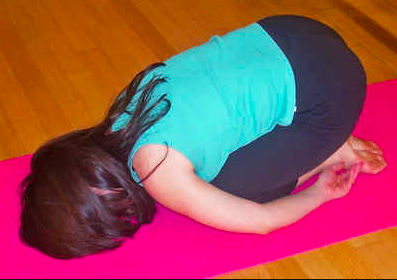
On your yoga mat, start by kneeling on your hands and knees similar to the position a baby assumes to crawl on the floor. Widen the knees apart fro m each other. Place the tops of your feet on the floor so your toes are not curled under and torso width apart. Your soles should be facing the ceiling. Bring the torso rest between the thighs. Your hips are bent and your buttocks are in the air. Lower the buttocks to the floor and extend the spine. Lengthen the neck as your forehead rests on the floor. Your arms can go along the body with palms up or facing toward you, next to the thighs as shown in the photo. The arms can reach in front of you, extended beyond your head on the floor with the palms down. Shoulders are wide. Allow your chest to sink to the floor. Take some long deep breaths with a focus on long exhalations. Let a sense of surrender into the pose.
Come out of the pose after a few to several long breaths. Rise up on an inhalation and press the tailbone down as you use your arms to bring your torso up.
Beginner Tips:
Place your forehead on folded blanket or your stacked hands if resting on the floor is not easy for you. If the knees are hurting, try placing a pillow between the heels and buttocks or a rolled washcloth between the thigh and calf at the inner knee to stop the joint from closing as much. Similarly, if the ankles are overstretched on the floor, get two towels and roll them up, placing under the ankles. Eventually the body stretches into this and other poses more easily so keep practicing and adjust to make it comfortable for you.
Contraindicating Conditions
Anterior Cruciate Ligament Tear
Arthritis Hip
Arthritis Knee
Bunion
Chondromalacia Patellae
GERD – Gastroesophageal Reflux Disease.
Herniated Lumbar Disc
Herniated Thoracic Disc
Posterior Total Hip Replacement
Retrolisthesis
Spinal Fracture (vertebral body), Compression Fracture
Total Knee Replacement
Conditions Helped
Adhesive Capsulitis
Alcoholism
Alzheimers disease
Anterior Total Hip Replacement
Anterolisthesis
Atrial Fibrillation
Chronic Fatigue Syndrome
Depression
Endometriosis
Hypertension
Lumbar Spinal Stenosis
Post Traumatic Stress Syndrome
Retrolisthesis
Shoulder Impingement
Spasm
Spondylolisthesis